

Dissectible Leyden Jar – Electrostatics Demonstrator
Dissectible Leyden Jar – Electrostatics Demonstrator
SKU:42LJD
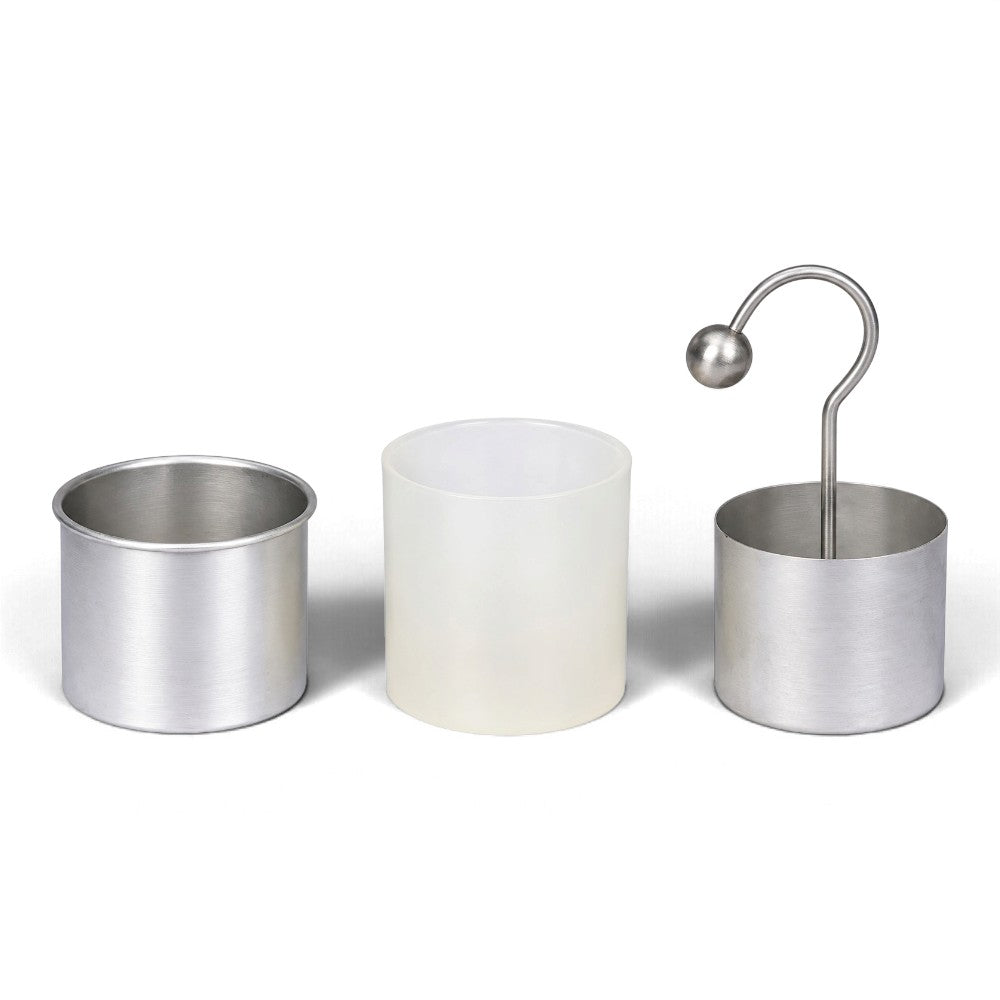
The Dissectible Leyden Jar is a classroom electrostatics apparatus for investigating electrical charge storage and the role of an insulating dielectric in a capacitor. Its removable components allow students to examine how a Leyden jar works and explore the distribution of charge after charging.
The apparatus includes two aluminium containers, a polystyrene dielectric liner, and an electrode with ball terminal. Instructions with experiments are included. The jar can be charged using a suitable electrostatic source, such as the Electrostatic High-Voltage Genecon (42EHVG) or Van de Graaff Generator (42VDG400).
Key Features
- Dissectible design with removable conductive containers and dielectric liner
- Demonstrates electrostatic charge storage and capacitor principles
- Includes an electrode with ball terminal
- Suitable for supervised school physics demonstrations
- Supplied with instructions and experiments
Components and Dimensions
- Inner aluminium container: approximately 60mm high × 80mm diameter
- Outer aluminium container: approximately 80mm high × 98mm diameter
- Polystyrene dielectric liner: approximately 105mm high × 90mm diameter
- Electrode and ball terminal
How Does a Leyden Jar Work?
A Leyden jar is an early form of capacitor used to store electrical energy. Its two metal containers act as conductive plates, separated by an insulating plastic cup known as the dielectric. When charged using a suitable electrostatic source, opposite charges accumulate on the conductors, storing energy in the electric field between them.
The dissectible design lets students examine the separate components and understand the relationship between conductors, insulators and electrical energy storage.
Classroom Investigations
- Investigate how electrical charge is stored in a capacitor.
- Explore the role of the dielectric in separating charged conductors.
- Compare the behaviour of a Leyden jar with other electrostatic apparatus.
- Discuss how grounding affects charge accumulation and discharge.
- Explore the historical development of capacitors and early electricity experiments.
Important Information
For supervised educational use with appropriate electrostatic equipment. Disconnect the charging source and safely discharge the apparatus before handling or disassembling it. Stored electrostatic charge may remain after the charging source is removed.
excl. GST
Couldn't load pickup availability